Guide · 14 October 2026
Knoll Cesca vs Brno chair: comparing two Bauhaus icons for dining and meeting rooms
Knoll Cesca vs Brno comes down to one question: are people going to pull the chair under a table, or sit in it for an hour? The Cesca is armless, light and narrow, and tucks away completely — it is the better dining chair. The Brno has arms built into its frame, thicker cushions and leather, and does not tuck under anything — it is the better meeting-room chair. Everything below is why, and what each one costs here.
| Cesca | Brno | |
| Designer | Marcel Breuer | Ludwig Mies van der Rohe |
| Designed | 1928 | c. 1930, for the Villa Tugendhat |
| Frame | Chrome-plated tubular steel | Polished chrome, tubular |
| Arms | Armless | Tubular arms, integral to the frame |
| Back and seat | Machine-woven cane back, upholstered black seat | Black leather, grade Z, thicker cushions |
| Dimensions | W 460 x D 580 x H 800 mm, seat height 460 mm | On request |
| Condition | New | Excellent |
| Source | Ex-display | Refurbished |
| Availability | 1 set of 2 available | 12 available |
| Retail | £1,404 per set of 2 | £1,887 |
| Here | £890 + VAT per set of 2 | £529 + VAT each |
Prices, grades and availability above are read from the two product pages as this page is built, so they are whatever is true today. Both are sold by enquiry — there is no checkout here.
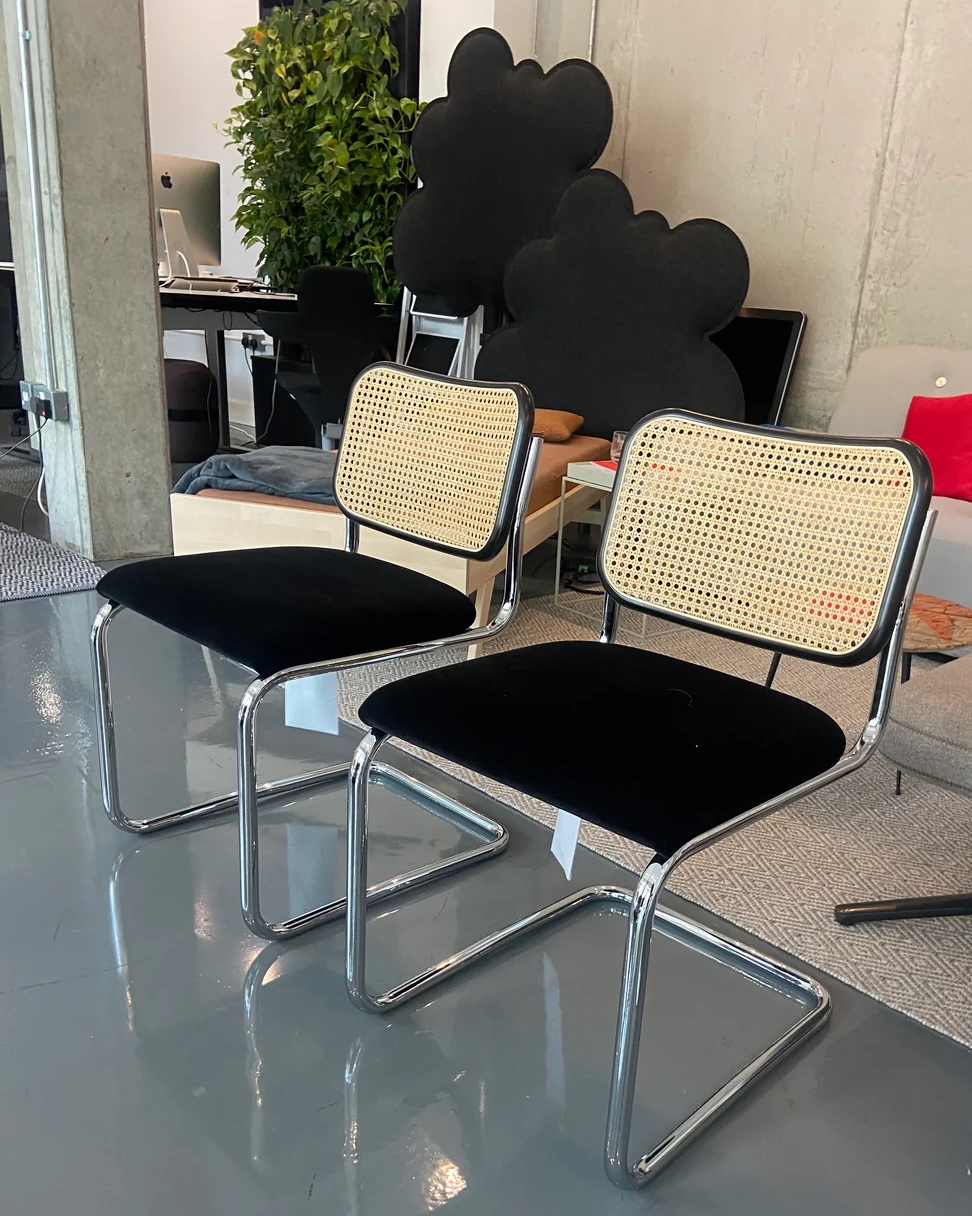
The story behind the Cesca: Marcel Breuer, 1928
Marcel Breuer had already worked out what bent tubular steel could do — the Wassily armchair came out of his Bauhaus years in 1925 — before he turned the material into a chair you could put around a table. The 1928 design did something the Wassily did not: it removed the back legs entirely. The frame runs forward under the seat, bends up at the front, and returns as a single continuous loop, so the whole chair balances on a front-to-back runner.
That cantilever was contested at the time, and it is worth knowing if you care about these things. Mart Stam had built a cantilevered chair in 1926, and the argument over who owned the principle ran through the German courts for years, eventually going Stam’s way on the idea itself. What was never in dispute is that Breuer’s version was the one that worked as a production chair: lighter, springier, and beautiful in a way the earlier attempts were not. The name came later and is domestic rather than grand — Breuer’s daughter was called Francesca.
Knoll took on the Breuer collection when it acquired the Italian manufacturer Gavina in 1968, and has made the Cesca ever since. The pair we have is the armless version, with a machine-woven cane back and an upholstered black seat on a chrome-plated tubular steel frame — ex-display, and sold as a set of two.
The story behind the Brno: Mies van der Rohe and the Villa Tugendhat
The Brno is a chair designed for one room. Around 1930, Mies van der Rohe and Lilly Reich were fitting out the Tugendhat House in Brno, and the dining area posed a problem: the Tugendhat chair they had designed for the living space was too generous to pull up to a dining table in a room with that much glass and that little margin. So they made a tighter one. The Brno is a cantilever like the Cesca, but with arms carried by the frame itself rather than added to it, which is why it looks substantial and still only touches the floor in two places.
Knoll has produced Mies’s furniture since the late 1940s, and makes the Brno in two quite different frames: a flat bar version, which is the one most people picture, and a tubular version. Ours is tubular — polished chrome, with the thicker cushion option, in black leather to Knoll’s grade Z. It has been refurbished and graded excellent, and there are enough of them to do a room.
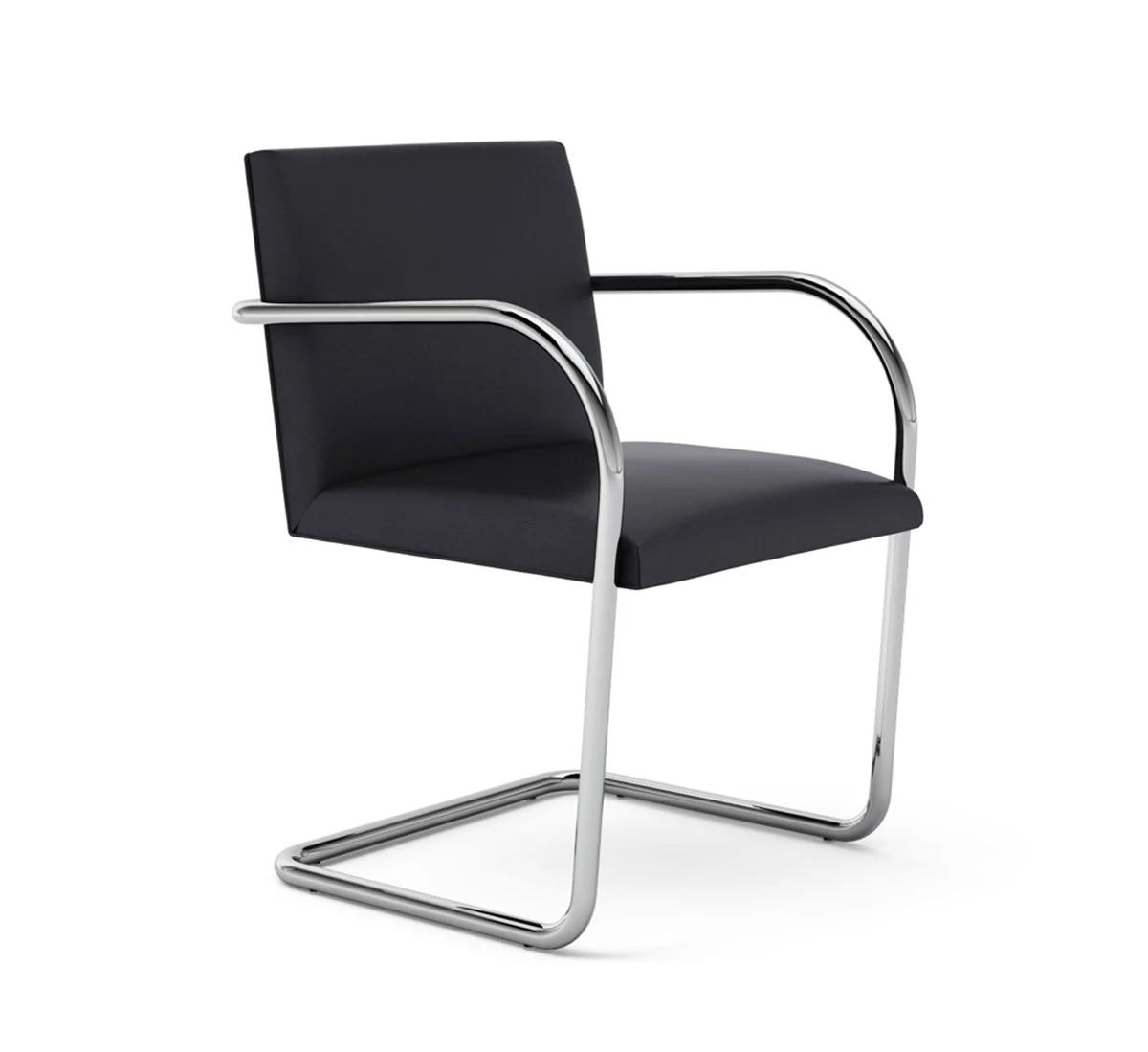
Comfort, proportions and cantilever design compared
The thing most comparisons miss is how much these two have in common. Both are cantilevers. Neither has back legs. Both carry their load through a steel runner, so both slide on a hard floor rather than catching, and both give a little as you move — which is the quiet reason tubular steel chairs are more comfortable than they look. If you have only ever sat on a copy with a rigid frame, you have not felt the part that matters.
Where they separate is mass. The Cesca is the lighter object in every sense. At 460 mm wide and 580 mm deep it takes up very little of a table edge, and the 460 mm seat height is standard dining height, so it works with an ordinary table without anyone perching or stooping. The cane back flexes and breathes, which matters more than it sounds in a warm room. You can pick one up with one hand.
The Brno is the opposite argument. The arms are structural, so they are rigid and they are where your forearms land for the whole meeting. The thicker cushions and the leather make it a chair that stays comfortable while you are not moving, which is a different skill from staying comfortable while you are. The trade is footprint: arms mean it stops at the table edge rather than disappearing under it, so a row of them around a boardroom table occupies the room permanently.
We publish the Cesca’s measurements because they are on the product record. The Brno’s are not, so we have not put a number on them here — ask us and we will measure the actual chair rather than quote you a catalogue.
Upholstery and frame options
The Cesca is usually seen in its purest form: a beech frame carrying hand- or machine-woven cane in both the seat and the back, with nothing upholstered at all. It is also made armless or with arms, and in fully upholstered versions where the cane disappears. The pair here is the middle option, and arguably the practical one for a dining table — cane in the back where you want the flex and the air, a padded seat where you want the comfort, and no cane on the surface people actually put their weight through.
The Brno’s big decision is the frame. Flat bar is the more sculptural, more expensive-looking option and the one that photographs best; tubular is the more robust and the more common in offices, and it is what we have. Then there is the cushion depth and the covering — Knoll runs its own upholstery grades, and this one is leather to grade Z. For a meeting room, leather is the sensible answer for the same reason it always is: it wipes, and it ages into something better rather than something tired.
On both chairs, chrome is chrome. It is hard-wearing and it is also the surface that records a room’s history in fine scratches, which is worth knowing before you look closely at anything pre-owned.
Which chair works best for dining rooms vs meeting rooms
For a dining table, take the Cesca. Armless means it goes all the way under, which keeps a room walkable and lets you put more people round a table than the arithmetic suggests. It is light enough that nobody minds moving it, and the cane back keeps the whole arrangement visually open — six solid chairs around a table reads as furniture, six Cescas reads as a room. The honest caveat is the cane. It is the part that shows daily use first, and it is the part that costs money to put right. In a household that eats at the table three times a day, think about that before you think about the price.
For a meeting room, take the Brno. Arms, leather and a deeper cushion are all the right specification for a chair somebody occupies for an hour without moving, and leather survives a room that hosts people who did not buy the furniture. The practical argument is quieter, though: there are twelve of these. The difficult thing about furnishing a boardroom from pre-owned stock is not finding a good chair, it is finding eight or twelve that match each other in frame finish, upholstery and production run. A matched dozen is rarer than any single chair on this site.
There is one nice irony in all of this. If you search for a Bauhaus dining chair you will be shown the Cesca, and you should be. But the Brno is the one that was actually designed as a dining chair, for a specific dining room in Brno, and it still works as one at a generous table where nobody needs to tuck in. A pair of Brnos at the ends of a long table, with Cescas down the sides, is not a compromise — it is closer to how both chairs were meant to be used.
How to identify genuine Knoll production
Both designs are among the most reproduced objects of the twentieth century, and “Cesca style” chairs are sold openly and cheaply everywhere. If you want an original Knoll chair rather than a tribute to one, there are two things to look at and they are both easy to photograph.
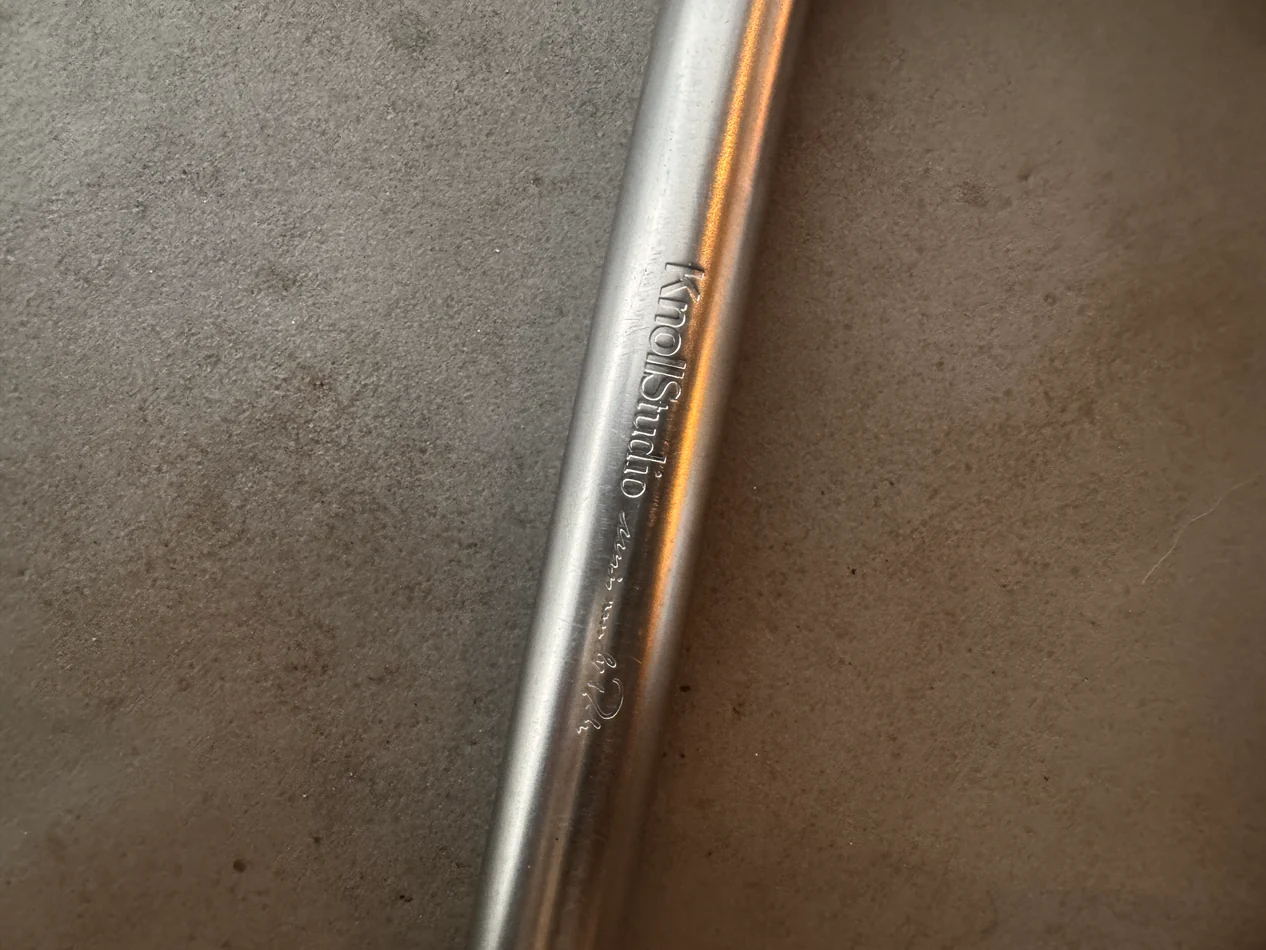
The first is the frame. Genuine KnollStudio production is marked: the KnollStudio name and the designer’s signature are stamped into the steel. On our Brno that stamp is on the chrome of the frame, and we photograph it, because it is the single most useful picture in the listing.
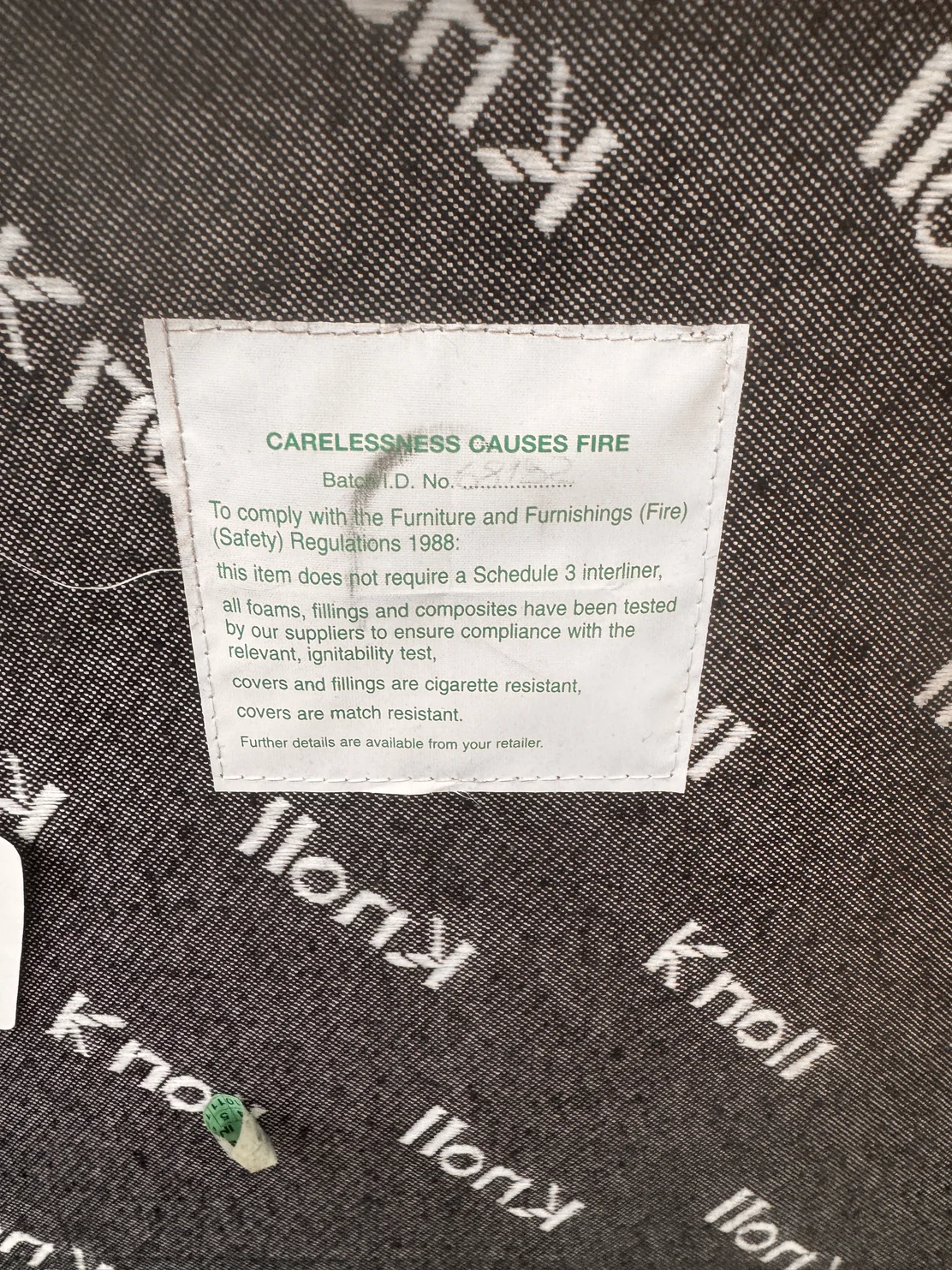
The second is the label. Upholstered Knoll pieces carry a fabric label underneath, and on anything sold into the UK there will be a fire-safety tag with it. That tag is quietly useful twice over: it tells you the chair was made or supplied for this market, and it is the thing a facilities manager will ask you for.
Neither mark is absolute proof — a stamp can be faked and a label can be lost — but a chair advertised as Knoll with no stamp, no label and a seller who has not looked is a chair to walk away from. The same reasoning, applied to a different designer, is set out at more length in our guide to spotting an original Eames Aluminium Chair.
Condition is a separate question from authenticity. Everything in our Second Life range is graded before it is listed, and our condition guide sets out exactly what each grade means; excess stock is new or ex-display and described as such. A fair original is still an original.
Knoll Cesca Chair, set of 2
Armless, cane back, upholstered black seat, chrome frame. Ex-display. Retail £1,404 per set of 2; here at £890 + VAT per set of 2, with 1 set of 2 available.
Knoll Brno Chair, black tubular hardware
Tubular arms, polished chrome, thicker cushions, black leather grade Z. Refurbished and graded excellent. Retail £1,887; here at £529 + VAT each, with 12 available.
Frequently asked questions
What is the difference between a Knoll Cesca and a Brno chair?
Both are cantilevers, so neither has back legs. The Cesca is Marcel Breuer’s 1928 design: lighter, armless in its most common form, with a woven cane back and a frame that visibly springs. The Brno is Mies van der Rohe’s, designed around 1930 for the Villa Tugendhat: heavier, fully upholstered, with arms built into the frame. The Cesca pulls right under a table; the Brno does not, but it is the more supportive chair to sit in for an hour.
Is the Cesca a good Bauhaus dining chair?
It is probably the Bauhaus dining chair. It is armless so it tucks fully under a table, narrow enough at 460 mm that you can fit more of them around one, light to move, and its 460 mm seat height matches standard dining height. The one thing to weigh is the cane: a woven back is the part that shows daily use first, so think about how hard the table actually gets worked.
Are cantilever chairs comfortable without back legs?
That is the point of them rather than a compromise. A tubular steel cantilever flexes under load, so the chair gives slightly as you shift, which is more comfortable than a rigid four-legged frame over a long sitting. It also means both chairs carry their weight through a front-to-back runner instead of four points, so they slide rather than catch on a hard floor.
How do you know a Knoll chair is original?
Genuine KnollStudio production carries the KnollStudio mark and the designer’s signature stamped into the frame, and upholstered pieces carry a Knoll fabric label underneath. Both designs are among the most copied in the world, so ask any seller for a close photograph of the frame stamp and the label before you commit. A stamp is not absolute proof, but its absence on a chair sold as Knoll is a question worth asking.
Can you buy Knoll chairs second-hand as a matched set?
Sometimes, and it is the hard part. Single chairs turn up constantly; eight or twelve that match in frame finish, upholstery and production year are much rarer, which is why office clearances and ex-display stock are the usual source for a boardroom set. If a matched set matters to you, ask how many are available before anything else.
Buying either of them
There is no checkout here. Tell us which chair, how many you need and your postcode, and we will confirm what is still available, the condition and the delivery cost, then send a payment link or an invoice. If you are weighing the two against each other for a specific room, say so in the enquiry — get in touch and we will tell you which one we would put in it.