Guide · 14 October 2026
How to spot an original Vitra Eames Aluminium Chair vs a replica: buyer’s checklist
The quickest way to identify an original Eames Aluminium Chair is to ignore the badge and look at how the seat is built. On the real thing the seat and back are one continuous panel stretched in tension between two cast aluminium side ribs. On almost every replica they are a rigid shell with padding over the top. If you need to tell a real Eames chair from a copy in one move, that is the move: it is visible in a photograph, obvious when you sit in it, and expensive enough to reproduce that copies rarely bother.
The five-second version
- Is the seat a sling or a shell? A suspended panel under tension is original. A padded shell is not.
- Who made it? Vitra or Herman Miller. Both are genuine. Neither is a worry; a chair branded neither is.
- How good is the casting? Crisp edges and an even finish on the side ribs. Seams, pitting and soft profiles mean a cheaper mould.
- How heavy is the base? Originals are substantial. Lightness is the easiest corner for a copy to cut.
- Is there a label — and does the rest agree with it? A label alone proves nothing, in either direction.
Why Eames Aluminium Chair replicas are so common
Charles and Ray Eames designed the Aluminium Group in 1958, for the house Eero Saarinen and Alexander Girard were building for J. Irwin Miller. It was meant to work indoors and out, which is why it has no upholstered cushion to speak of and why its silhouette is so thin. That silhouette is the problem: it is one of the most recognisable shapes in twentieth-century furniture, and a recognisable shape is exactly what a copy needs.
An Eames Aluminium Chair replica is cheap to make because the outline can be approximated without the engineering underneath it. You can cast a rough side rib, bolt it to a shell, staple some foam and leather over the shell, and from two metres away in a photograph it reads as the real chair. What you cannot cheaply reproduce is a panel held at the right tension between two precisely cast ribs, which is the part that makes the original comfortable and the part that survives twenty years of daily use.
The second reason is price. Retail for a single original runs into four figures — the chair on this site lists at £3,408 + VAT each — so there is a large gap for a copy to sit in, and a large incentive to describe a copy ambiguously. “Eames style”, “inspired by” and “designer aluminium chair” are all honest enough phrasings. The listings worth worrying about are the ones that use none of them and no manufacturer name either.
Vitra vs Herman Miller: who makes the original, and where
This is the single most common confusion, and it costs people sales they should have made. Both Vitra and Herman Miller produce the Eames Aluminium Group under licence. They are not rivals selling a real one and a fake one. They are two authorised manufacturers with different territories: Vitra for Europe and the Middle East, Herman Miller for the United States and most other markets. The arrangement goes back to a partnership that began in the 1950s and settled into its present shape in the mid-1980s.
So a Vitra chair bought in the UK is the authorised European original. It is not a licensed imitation of an American chair, and it does not need to be “upgraded” to a Herman Miller one. A Herman Miller chair in the UK is equally genuine — it has simply been imported.
The naming is where the useful signal is. EA numbers are Vitra’s: EA117 is one of the swivel work chairs on a five-star base, and the EA coding runs across the whole Aluminium Group. Herman Miller does not use them. It sells the same family as the Aluminum Group, in the American spelling, under descriptive names rather than codes. That gives you a quick cross-check when you are asking whether a Vitra EA117 is authentic: the code and the maker should agree with each other. A listing offering a “Herman Miller EA117” has mixed two systems. Often that is just a reseller copying text from somewhere else, but it is always worth a question.
Checking labels, stamps and underside markings
Turn the chair over. Both manufacturers label their work, and the label usually lives on the underside of the seat panel or on the underside of the base. Vitra’s carries its logo and identifies the model; many chairs also carry a moulded or badged logo on the frame itself, where the panel meets the side rib. The chair we currently hold has exactly that — a Vitra badge on the seat frame, photographed below so you know what you are looking for.
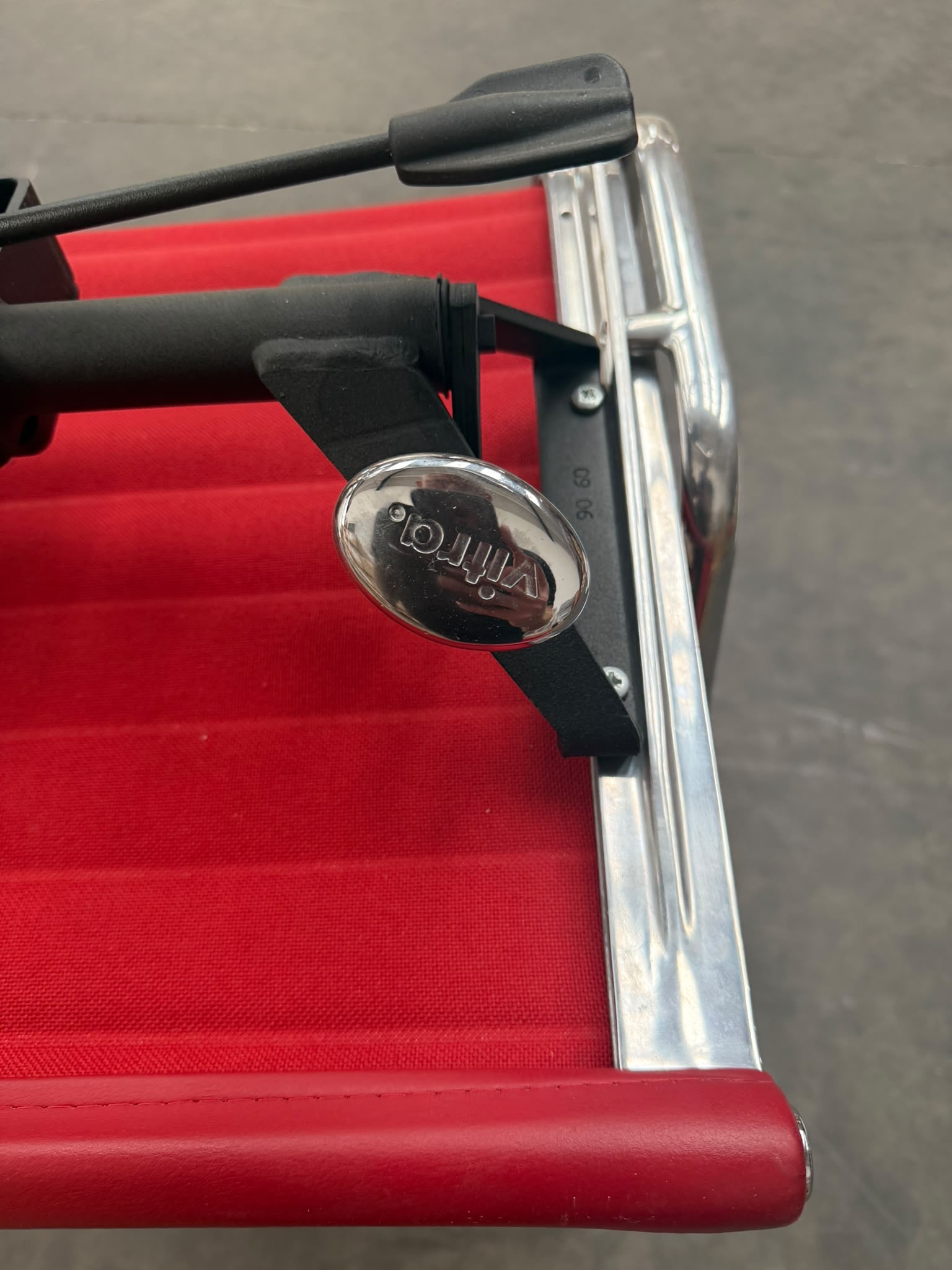
Now the honest part, because this is where most buying guides overpromise. A printed label is weak evidence in both directions. It can be reproduced by anyone willing to print one, and it falls off, fades or gets scraped away in normal office life, so plenty of genuine chairs have none. A badge moulded or fixed into the frame is harder to fake than a sticker, and older chairs carry different labels from newer ones because the labelling has changed across six decades of production.
Treat markings as corroboration. If the label says Vitra and the casting is crisp and the panel is a proper sling and the base has real weight, they all agree and you can relax. If the label says Vitra and the seat is a padded shell, believe the seat.
Casting, upholstery and base details replicas get wrong
The aluminium side ribs
The two side members are die-cast, and good die casting looks like it. Run a finger along the top edge of the rib and around the arm: an original has a consistent, crisp profile with no casting seam ridged along it, and a polished one is evenly polished right into the curves. Copies typically show a visible seam line where the mould halves met, small pitting or porosity in the surface, softened and slightly rounded edges where the original is sharp, and buffing that goes bright on the flats and dull in the recesses. Look especially at the junction where the rib meets the arm and where it meets the spine at the back — the awkward geometry is where a cheap mould gives itself away.
The suspended seat panel
This is the one that matters. On an original, the covering is a single panel running from the top of the back to the front of the seat, suspended under tension between the two ribs and held in a channel along each side. The horizontal ribs across its face are formed by the way the panel is made, so they are evenly spaced and parallel and they stay that way under load. The edges disappear cleanly into the side channels: no staples, no glue line, no gap you can get a fingernail into.
Then sit in it. An original gives. The panel takes your shape and the whole seat has a slight, controlled flex, which is the entire point of the design. A shell does not move, and you can feel its rigid edge under the padding at the front of the seat.
One nuance worth knowing, because it stops people rejecting good chairs: a genuinely old sling can slacken. Some softening after fifteen or twenty years is normal wear and is itself evidence that there is a real suspended panel in there. What is not normal is puckering, ribs that wander out of parallel, or upholstery that has been re-stapled around the edges.
The base, column and castors
Pick up the base, or ask the seller to. Weight is the hardest thing for a copy to fake because it is simply more metal and therefore more cost. An original five-star base is a substantial aluminium casting with the same finish quality as the ribs, and the swivel versions sit on a properly engineered column that moves smoothly and holds its height without creeping down. Copies feel light in the hand, often pair a thin base with visibly cheaper plastic castors, and tend to have a wobble where the column meets the base.
Questions to ask a pre-owned seller
Most of the checks above need a photograph the seller has not taken. Asking for them is reasonable, and how someone answers tells you as much as the answer does. For a pre-owned Eames chair we would ask:
- Who made it, and can you photograph the label or badge? Vitra or Herman Miller. “Eames” on its own is a designer, not a manufacturer.
- Which model is it? Back height and base type separate the variants. Get the EA number if it is a Vitra.
- Can I see the underside and the base? The two angles no listing photograph ever includes, and the two that answer the most.
- Can I see a close-up where the panel meets the side rib? Sling or shell, settled in one picture.
- Where did it come from? An office clearance, a showroom floor, an ex-demo. Provenance is not proof, but a seller who knows is a seller who looked.
- If it is a set, do they match? Mixed production years and mixed leather colours are common in clearances and perfectly fine — as long as you know before it arrives.
- What exactly is wrong with it? Any honest pre-owned seller can answer this specifically. Vagueness here is the real warning sign.
How our condition grades apply to Eames chairs
Everything in our Second Life range is graded before it goes on the site, and the full definitions are in our condition guide. What they mean on a chair like this one is fairly specific. On an Eames Aluminium Chair, wear concentrates in three places: the leather or fabric of the panel, where it creases and softens along the seat front; the polished aluminium of the ribs and base, which picks up fine scratches from desks and other chairs; and the castors, which are consumable.
So excellent on one of these means blemishes you have to hunt for — a chair that has been sat in, not a chair that looks it. Good means a few visible marks: light scratching on the aluminium, some patina in the leather at the front edge. Fair means flaws you will see from across the room and a chair that still works properly and has plenty of life in it. None of these grades describes structural damage, and none of them describes a slack panel, because we would say so separately.
A grade is about condition, never about authenticity. A fair original is still an original. An excellent replica is still a replica.
Frequently asked questions
How do you tell a real Eames chair from a replica?
Start with the structure rather than the badge. On an original the seat and back are one continuous panel held in tension between two cast aluminium side ribs, so the chair flexes and conforms as you sit. Most replicas build a rigid shell and upholster over it, which is obvious the moment you sit down and obvious again when you look at how the panel meets the side rib. Then check the maker, the casting quality and the base.
Is a Vitra Eames chair an original, or does it have to be Herman Miller?
Both are originals. The two companies make the Eames Aluminium Group under licence for different territories — Vitra for Europe and the Middle East, Herman Miller for the United States and most other markets. A Vitra chair in the UK is the authorised European product, not a copy of an American one. What should make you cautious is a chair branded neither.
What does EA117 mean, and is a Vitra EA117 authentic?
EA is Vitra’s own model coding for the Eames Aluminium Group, and EA117 is one of the swivel work chairs on a five-star base. The code itself is a reasonable sign you are looking at the European product, because Herman Miller does not use EA numbers — it sells the same family as the Aluminum Group, in American spelling, under names rather than codes. A listing advertising a Herman Miller EA117 is mixing two naming systems, which is worth a question.
Do Eames Aluminium Chair replicas have labels?
Some do. A label is printed, and anything printed can be reproduced, so treat it as supporting evidence rather than proof. It is also normal for a genuinely old chair to have lost its label altogether after twenty years in an office. Weigh the label alongside the things that are expensive to fake: the casting, the tension of the panel and the weight of the base.
Are pre-owned Eames chairs worth buying?
A pre-owned Eames chair is usually the only way to own one at a sensible price, and the construction is built to be sat in for decades. The risk is not wear, which you can see and grade. The risk is paying an original price for a replica, which is why it is worth asking for photographs of the underside, the base and the join between the panel and the side ribs before you commit.
Where we stand on this
The name of this business is the whole policy: we sell originals, from excess stock and from showroom, ex-demo and refurbished sources, and we would rather talk you out of a piece than sell you something you are unsure about. If you are looking at an Eames chair somewhere else and want a second opinion on a photograph, send it to us — see contact. We would rather you bought the right chair, wherever it comes from.
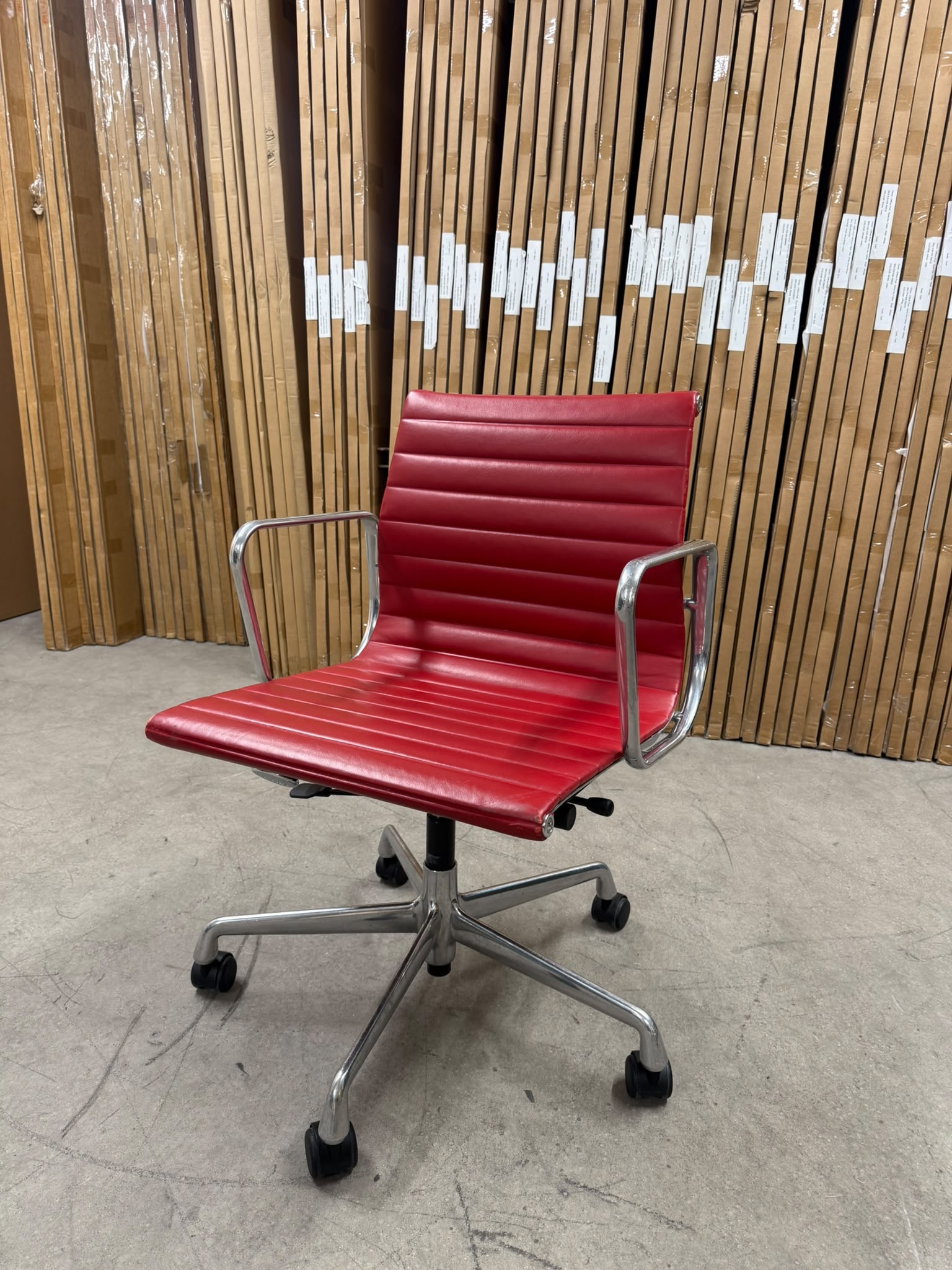
The EA117 we currently hold
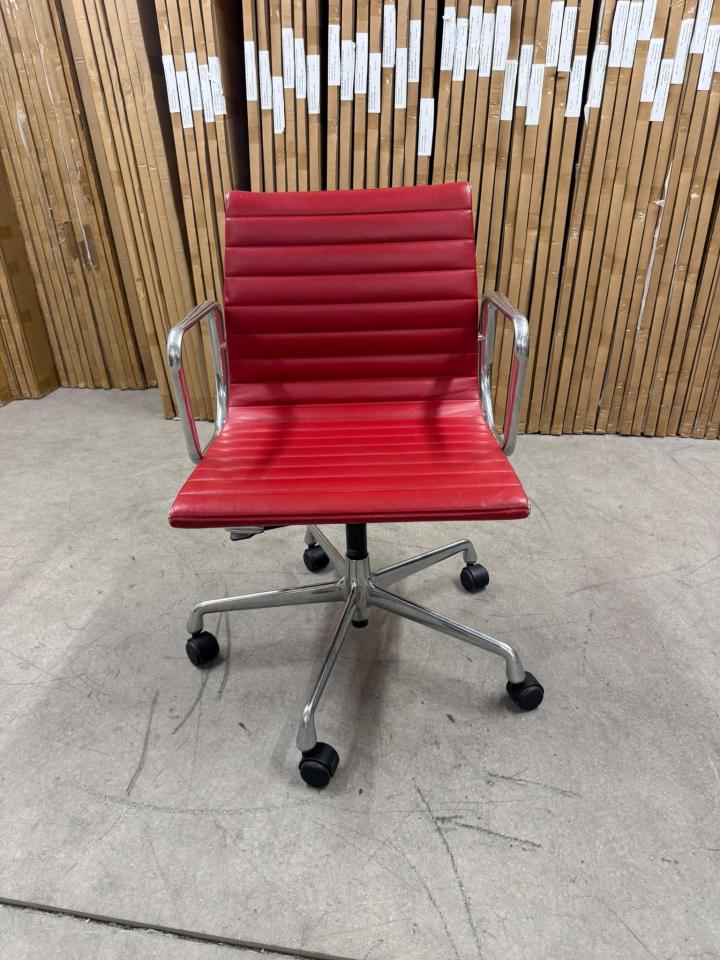
A Vitra Eames Aluminium Group EA117 in red leather, on a chrome five-star base, from our Second Life range. Retail is £3,408 + VAT each; it is here at £559 + VAT each. Condition is on request — ask us and we will tell you exactly what it is and send you whatever photographs you want, including the ones this guide says to ask for.