Guide · 21 October 2026
Silen Zen vs Framery One: which soundproof phone booth to buy
Silen Zen vs Framery One is a choice between footprint and room. The two booths are 0.6 dB apart on speech reduction, which nobody can hear, so the acoustic rating is not the decision. The Framery One Essentials takes 1.22 m² and is £6,900.00 with 3 available for immediate delivery. The Silen Space 1.5 Zen takes about 1.60 m², has smart glass and a wider cabin, and is £4,995.00 + VAT ex-display against a £16,900 + VAT retail price. Below is every measurement side by side, and which one we would put in a small studio rather than a full floor.
| Silen Zen 1.5 | Framery One | |
| Model | Silen Space 1.5 Zen | Framery One Essentials |
| Capacity | 1 person | 1 person, one seat and one desk |
| External size | W 1450 x D 1100 x H 2290 mm | W 1220 x D 1000 x H 2255 mm |
| Internal size | W 1250 x D 1010 x H 2050 mm | On request |
| Floor area | 1.60 m² | 1.22 m² |
| Weight | 415 kg | 325 kg |
| Speech reduction | 30.6 dB, ISO 23351-1:2020, Class A | 30 dB, ISO 23351-1 |
| Ventilation | Automatic, from 50 l/s | Air flow, rate not stated |
| Power | 1 socket 110–240 V (10 A), USB-A and USB-C | 1 socket and 65 W USB-C |
| Connectivity | Not stated | 4G module (Framery Connect) |
| Source | Ex-display | Excess stock, new and boxed |
| Availability | 1 available | 3 available for immediate delivery |
| Retail | £16,900 + VAT | On request |
| Here | £4,995.00 + VAT | £6,900.00 |
Prices, grades and availability above are read from the two product pages as this page is built, so they are whatever is true today. Floor areas are worked out from the external measurements. Both are sold by enquiry — there is no checkout here.
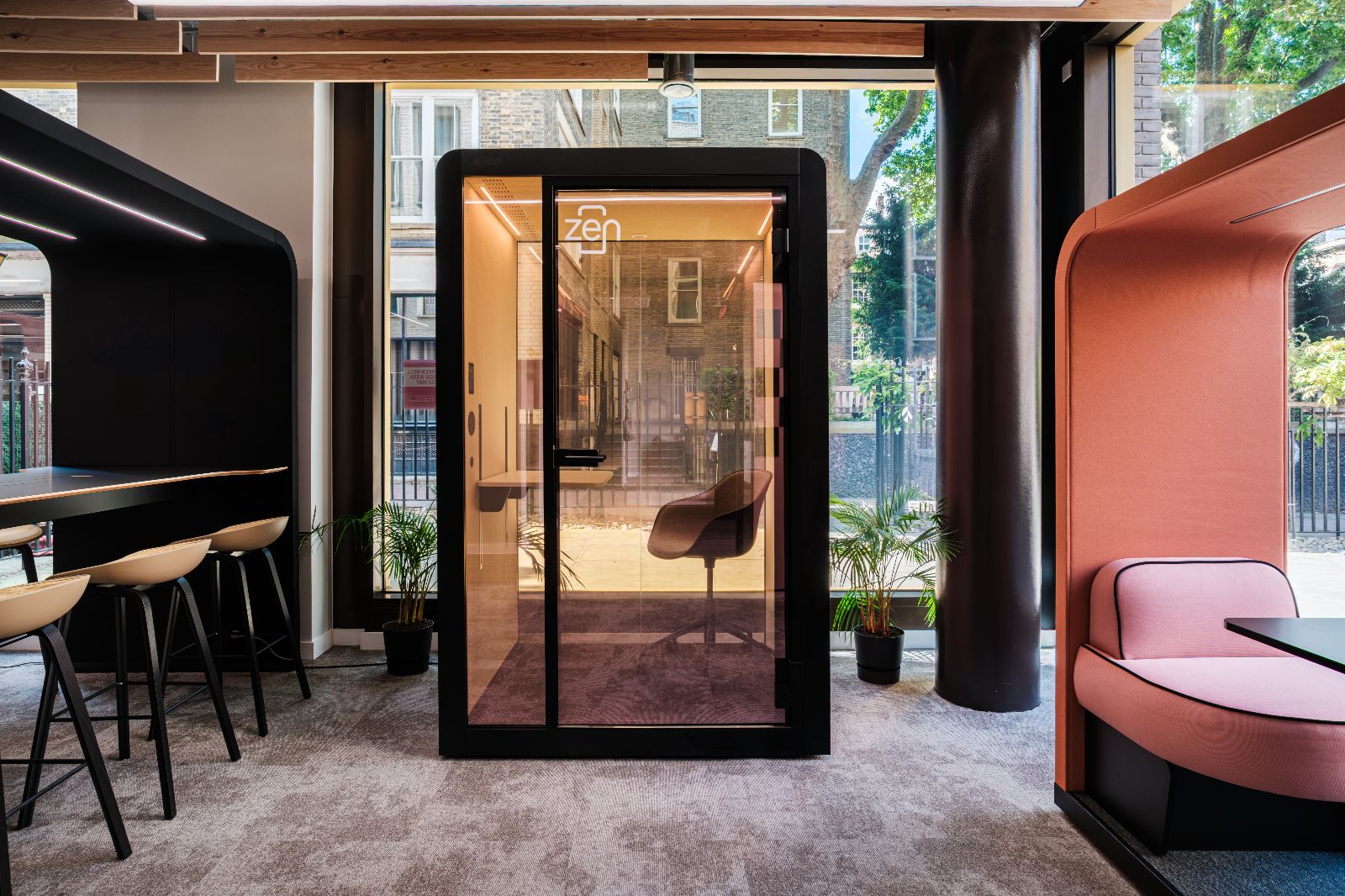
Footprint and ceiling height: what each pod needs clear
Footprint is the constraint that actually governs this decision, so start there. The Framery One Essentials is W 1220 x D 1000 mm, which is 1.22 m². The Silen Space 1.5 Zen is W 1450 x D 1100 mm, which is about 1.60 m². The Silen takes roughly 31 per cent more floor than the Framery, or about 0.38 m² more.
That gap sounds small written down and does not feel small in a room. On a tight floor it is the difference between a booth that sits where the print station used to be and one that pushes a desk out of position. Mark both footprints on the floor in tape before you commit to either. It takes ten minutes and it is the only check that never lies to you.
The extra width buys something real, though, and this is the number worth knowing. The Silen’s internal cabin is W 1250 x D 1010 x H 2050 mm. Its inside is 30 mm wider than the Framery’s outside. If the person using the booth is tall, broad or spreads out with a laptop and a notebook, that is a noticeably roomier place to sit for an hour. Our Framery listing does not record internal measurements, so we have not put a number on them here — ask us and we will measure the actual unit rather than quote you a catalogue.
Height is almost a non-issue between these two. The Framery is 2255 mm tall, the Silen 2290 mm, a difference of 35 mm. What matters is not the slab height on a drawing but the clear height at the exact spot the pod will stand, under ductwork, lighting trays and sprinkler heads, with room to stand the unit upright while it is installed. Measure at the position.
Weight deserves a line of its own because it is the detail people check last and regret first. The Framery is 325 kg and the Silen 415 kg, so the Silen is 90 kg heavier, about 28 per cent. On a ground floor slab neither is a question. On an upper storey, a raised access floor or a timber structure, 415 kg concentrated in 1.60 m² is worth putting to whoever looks after the building. The same goes for the route in: lift capacity, door widths and stair turns stop more pod deliveries than floor area ever does. Our delivery and collection page covers how we move items at this weight.
What the sound reduction figure actually covers
Both booths quote ISO 23351-1, and that is the useful part. The standard was written to measure how well an enclosure contains a conversation, rather than how much general noise a panel blocks, so two products quoting it can be compared directly. A supplier quoting a bare decibel figure with no standard beside it is not telling you anything you can use.
The Silen Space 1.5 Zen is rated 30.6 dB of speech level reduction under ISO 23351-1:2020, and its listing states Class A. The Framery One Essentials is rated 30 dB under ISO 23351-1. Class A under that standard begins at 30 dB, so the Framery sits right on the threshold, but our listing does not state a class and we are not going to assign it one.
The honest reading of 0.6 dB is that it is nothing. Most people need somewhere around 3 dB before they notice a change in level at all, so the gap between these two is well below what anybody will hear in a working office. Treat them as acoustically equivalent and spend the decision somewhere it counts.
What does 30 dB give you in practice? A normal speaking voice is around 60 dB close up, so roughly 30 dB of reduction leaves about the level of quiet background noise outside the booth. Someone at the nearest desk will know a person is in there. They will not be able to follow the words, and intelligible speech is the thing that actually breaks concentration in an open-plan room.
Say this plainly to whoever signs off the purchase, because the category’s own marketing does not. These are sound reduction, not recording studios. Neither booth will contain a raised voice, a speakerphone at full volume or a confidential conversation held loudly, and neither is rated to. If the requirement is genuine confidentiality rather than fewer overheard calls, a pod is the wrong product and we will say so. We go further into the 30 dB figure in our guide to the Framery One Essentials.
Ventilation, power and data: one cable or three
The short answer is one cable, for both. Neither booth is wired into the building and neither needs a network drop. This is the question that holds up more purchases than it should, so it is worth settling early.
The Framery control panel carries one power socket and a 65 W high-power USB-C, which runs and charges a laptop without a separate adapter. The Silen carries one 110 to 240 V socket at 10 A, plus USB-A and USB-C; our listing does not state a charging wattage for it, so we have not quoted one. Both plug into an ordinary socket. The real job is getting a socket to the spot the pod will stand, which means a floor box or a dado run, not a rewire.
On data the two differ, and it is the one specification gap that is genuinely one-way. The Framery includes a 4G module for updates and digital services, which Framery calls Connect. That means the booth reports on itself over mobile data without touching your network, and on a floor where you are trying to justify a second or third pod, usage figures are the argument that works. Our Silen listing states no network connectivity at all, so assume it has none.
Ventilation is where the Silen listing is the more detailed of the two. It specifies automatic air circulation from 50 l/s, drawing 3.4 W on standby, 6.8 W in use and 7.09 W at maximum. Automatic matters more than the airflow number: the fan responds to occupancy rather than running flat out or waiting for somebody to press a button, and a stuffy booth is the single most common reason a pod stops being used three months after it arrives.
The Framery listing records air flow, an occupancy light and LED ceiling and wall AV lighting, but no flow rate. We are not going to put a number against it that our own product record does not carry. If the ventilation figure is decisive for you — and in a warm south-facing office it reasonably might be — ask us and we will get the specification from Framery rather than guess.
One feature on the Silen has no equivalent on the Framery at all. The whole front is smart glass, switchable from clear to private at a touch, and the booth has a Zen mode that plays calming audio with Space, Forest and Dream settings. Smart glass is the more practical of the two: a glass-fronted booth in the middle of a floor is a fishbowl, and being able to make it opaque for a difficult call is the difference between a booth people book and a booth people avoid.
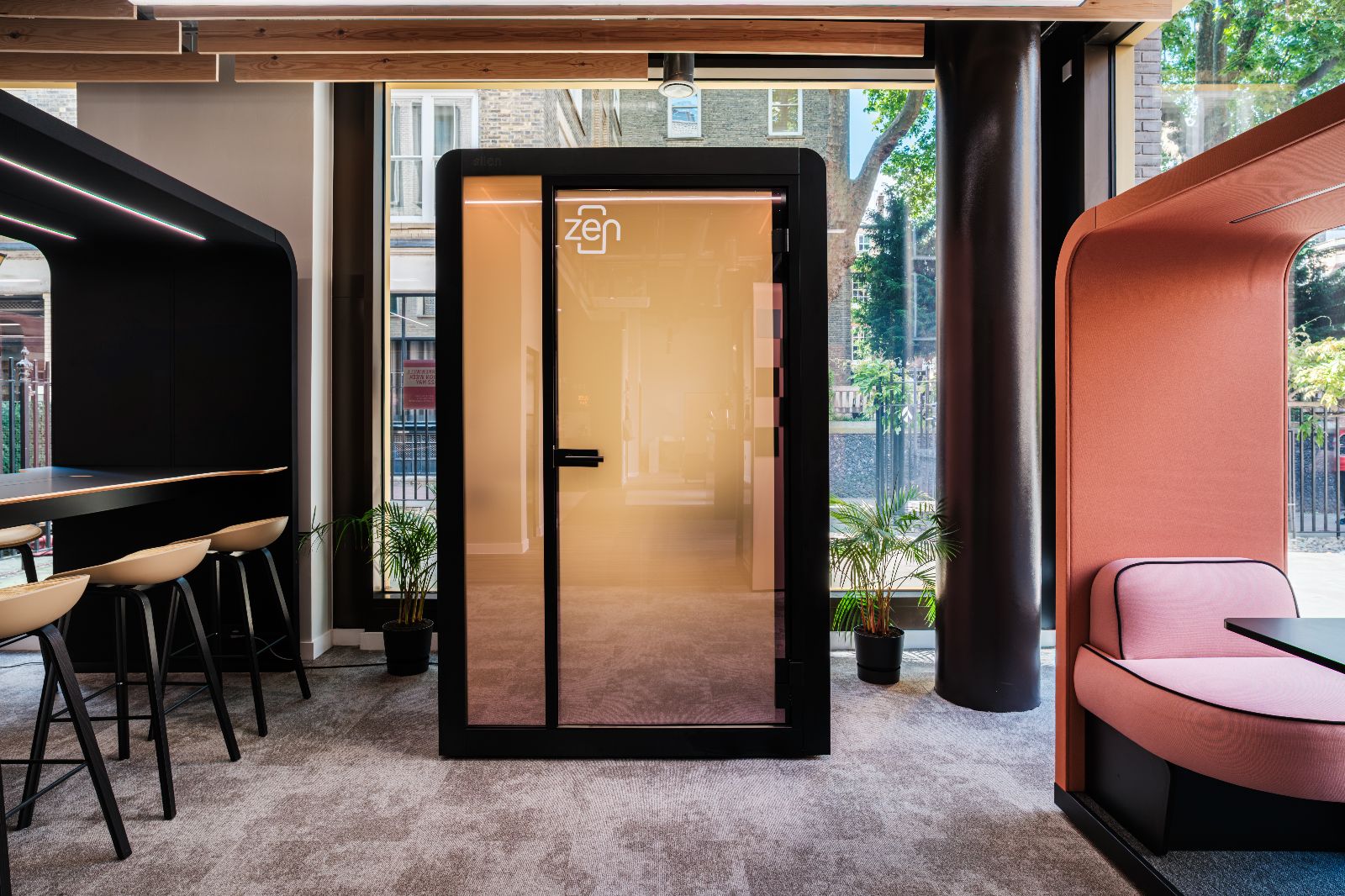
New vs used price bands for both models
Here is the first thing to be straight about: neither of these two is a used pod in the way people usually mean it. One is new and boxed, the other is ex-display from our own showroom. Both sit well below retail, for different reasons.
What each one costs here
The Framery One Essentials is £6,900.00, new in its original packaging, with 3 available for immediate delivery. It is excess stock, which usually means surplus from a cancelled or over-ordered project. It has never been installed anywhere. Our listing carries no retail price for it, so we are not quoting a saving percentage we cannot support.
The Silen Space 1.5 Zen is £4,995.00 + VAT against a retail price of £16,900 + VAT, with 1 available. That is about 70 per cent below retail, or roughly 11,900 pounds off, and it is ex-display from our own showroom rather than out of an office. It is graded new.
Compare the two numbers carefully, because the VAT line differs between the listings. The Silen is quoted plus VAT and the Framery price is quoted without a VAT note against it. Before you put either in a budget, ask us to confirm both on the same basis. We would rather answer that question than have you compare two prices that are not the same kind of number.
When a second-hand pod is the better buy
When you need one booth and you are buying a specific unit you can look at. At about 70 per cent below retail, the Silen is the clearest case on this site: you are paying for a pod that stood in a showroom rather than an office, and the smart glass and electrically height-adjustable desk at that price are specification you would not get new for the money. Ex-display stock is also the quickest route to a pod that is already in the country.
When it is not worth the saving
When you need several that match. Ex-display and excess stock arrive in ones and twos, so two pods bought three months apart will differ in finish, specification or generation, and on an open floor that reads as a mistake rather than a saving. There is one Silen Zen here, and when it is gone we cannot get another the same.
It is also the wrong buy if nobody can inspect it and the grade is doing all the work. Everything in our Second Life range is graded before it is listed and our condition guide sets out what each grade means, but on a pod the parts that matter are the door seal, the glass and the ventilation unit, because those are the moving parts. Ask for photographs of the door closed and ask whether the fan has run recently. If a seller cannot answer that about a pod they are selling, the discount is not the point.
Which one for a 6-person studio, which for a 40-desk floor
For a 6-person studio, take the Framery One Essentials. Floor space is the binding constraint at that size, and 1.22 m² against 1.60 m² decides it on its own. In a studio that small one booth covers everybody, so you are not buying a matched set and the single-unit problem never arises. It is also 90 kg lighter, which matters more than it sounds if you are above the ground floor in an older building. There are three of them, so you are not racing anybody for the last one.
For a 40-desk floor, the honest answer is both, doing different jobs. A floor that size needs more than one booth, and a rollout has to be standardised: the same pod, the same specification, so people learn one booth and facilities hold one set of spares. Three matched Framery units is the start of that, and Connect gives you the usage data to justify the fourth and fifth when the first three are permanently busy. That is the argument that gets signed off.
The Silen cannot be the floor standard, and we would not sell it to you as one, because there is only one. What it is very good at on a floor that size is the single better room: the booth you put near the quiet end for long calls, difficult conversations and the one person who needs to concentrate for three hours. Smart glass and the roomier cabin are worth more in that role than in a general-purpose booth, and Zen mode is the kind of thing people either use daily or never touch.
If you only take one line from this: pick on footprint and on how many you need, not on the acoustic rating. The two booths are 0.6 dB apart and 0.38 m² apart, and only one of those numbers will change how the room works.
Silen Zen work pod 1.5
Smart glass, Zen mode, Class A acoustics, electrically height-adjustable desk, one person. Ex-display and graded new. Retail £16,900 + VAT; here at £4,995.00 + VAT, with 1 available.
Framery One Essentials soundproof phone booth
30 dB ISO 23351-1, 4G Connect module, 65 W USB-C, height-adjustable desk and seat, in black. New and boxed from excess stock, at £6,900.00, with 3 available for immediate delivery.
Frequently asked questions
Which is quieter, the Silen Zen or the Framery One?
On paper the Silen, by 0.6 dB, and that is a difference nobody can hear. The Silen Space 1.5 Zen is rated 30.6 dB of speech level reduction under ISO 23351-1:2020, Class A. The Framery One Essentials is rated 30 dB under ISO 23351-1. Both are measured to the same standard, so the figures are directly comparable, and 0.6 dB is far below the roughly 3 dB most people need before they notice a change at all. Choose between these two on footprint, ventilation and price, not on the acoustic rating.
Will a phone booth block a normal speaking voice?
It will stop the words being intelligible, which is the thing that actually breaks concentration nearby. It will not make the booth silent. A normal speaking voice is around 60 dB close up, so about 30 dB of speech level reduction leaves roughly the level of quiet background noise outside the booth. Someone working alongside it will know a person is in there and will not be able to follow the conversation. These are sound reduction, not recording studios, and anyone selling them as soundproof is overstating it.
How much floor space does each pod need?
The Framery One Essentials is W 1220 x D 1000 mm, so 1.22 square metres. The Silen Space 1.5 Zen is W 1450 x D 1100 mm, so about 1.60 square metres. The Silen takes roughly 31 per cent more floor. Both need clear access around the door as well as the footprint itself, and you should measure the real route in: a lift, a stair turn or a door frame stops more deliveries than the floor area ever does.
What ceiling height do you need for an office pod?
More than the pod is tall, and the two are close. The Framery One Essentials is 2255 mm high and the Silen Space 1.5 Zen is 2290 mm, a difference of 35 mm. The height that matters is the clear height at the spot the pod will stand, under any ductwork, lighting or sprinkler heads, plus room to stand the unit up during installation. Measure at the position rather than taking the slab height from a drawing.
Is a used office phone booth worth buying in the UK?
Usually yes on price, as long as you are buying a specific unit rather than a quantity. Our Silen Space 1.5 Zen is ex-display from our own showroom at 4,995 pounds plus VAT against a retail price of 16,900 pounds plus VAT, which is about 70 per cent below. The case weakens when you need several matched booths, because ex-display and excess stock arrive in ones and twos, and two pods bought months apart rarely match in finish or specification.
Do these pods need wiring in by an electrician?
Neither is wired into the building. Each one runs from a single ordinary socket: the Framery control panel carries one power socket and a 65 W USB-C, and the Silen carries one 110 to 240 V socket at 10 A plus USB-A and USB-C. Neither needs a network cable either, and the Framery includes a 4G module for its connected services. The real job is getting a socket to the place the pod will stand, which is a floor box or a dado run rather than a rewire.
Buying either of them
There is no checkout here. Tell us which booth, how many you need and your postcode, and we will confirm what is still available, the condition and the delivery cost, then send a payment link or an invoice. If you are weighing the two against each other for a particular floor, send us the clear height and the route in — get in touch and we will tell you which one we would put in it. Our how to buy page sets out the rest.